



Subscribe to Our Updates
Join our community and be the first to receive exclusive insights
You are subscribed now!


.svg)

Products
Solutions
Resources
The 320 MHz channel is the widest Wi-Fi channel bandwidth introduced with Wi-Fi 7 (IEEE 802.11be) — double the maximum 160 MHz channel width available in Wi-Fi 6. It is available exclusively in the 6 GHz band, where enough contiguous, uncongested spectrum exists to support it.
Channel bandwidth is one of the primary levers for increasing wireless throughput: the wider the channel, the more data can be transmitted in a given unit of time. Wi-Fi has progressively widened its maximum channel size across generations, and Wi-Fi 7's 320 MHz channel continues that trajectory, doubling the maximum available bandwidth again.
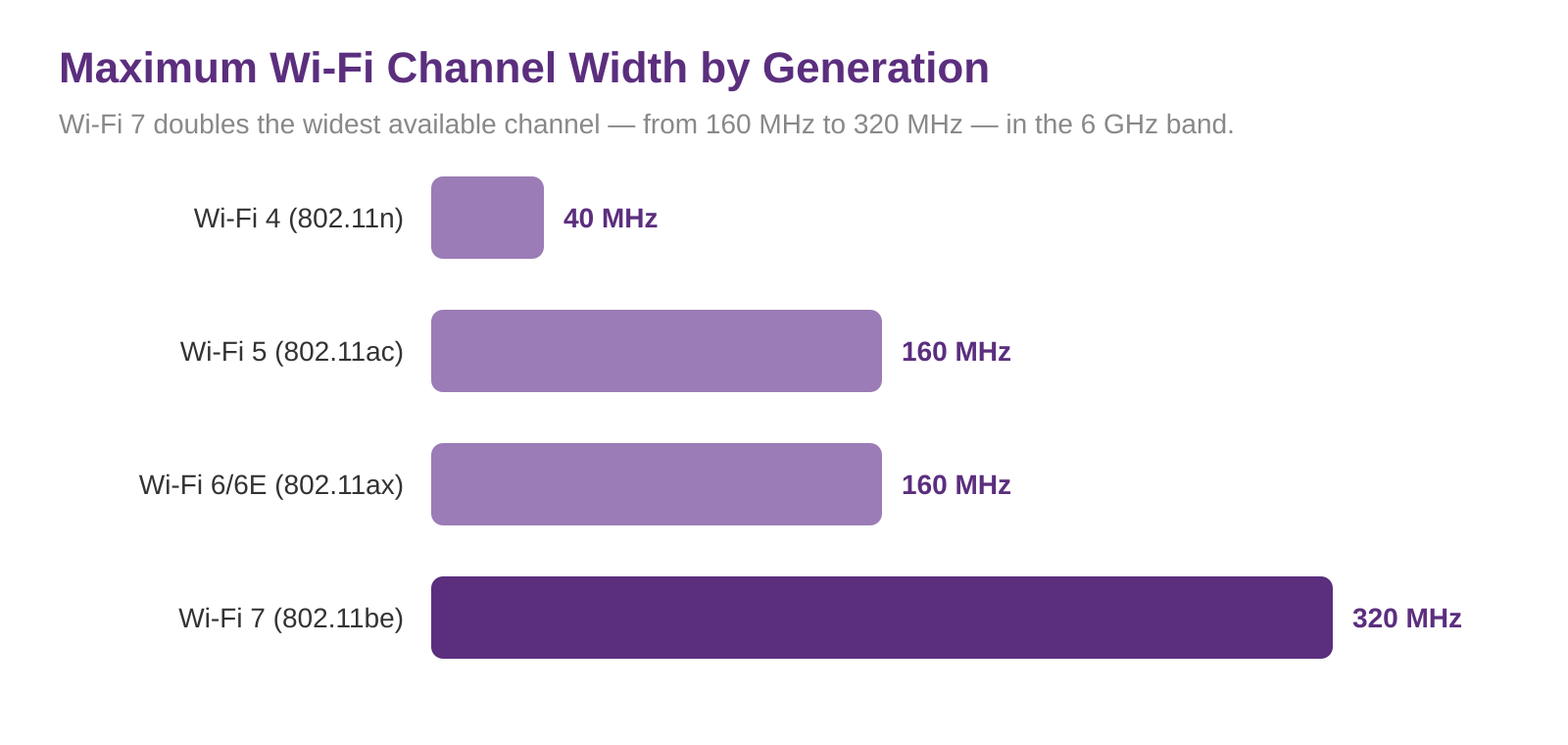
A 320 MHz channel supports significantly higher peak PHY data rates than an equivalent 160 MHz channel, and combines with 4K-QAM, Multi-Link Operation, and Multi-RU Allocation to deliver Wi-Fi 7's headline throughput gains. Because 320 MHz channels require a wide, contiguous, and largely interference-free block of spectrum, they depend on 6 GHz band availability and regional regulatory allocation.
Key takeaway: The 320 MHz channel is the single largest contributor to Wi-Fi 7's peak throughput increase, but its practical benefit depends on 6 GHz spectrum availability and a network design that accounts for regional regulations and RF conditions.