Subscribe to Our Updates
Join our community and be the first to receive exclusive insights
You are subscribed now!



Products
Solutions
Resources
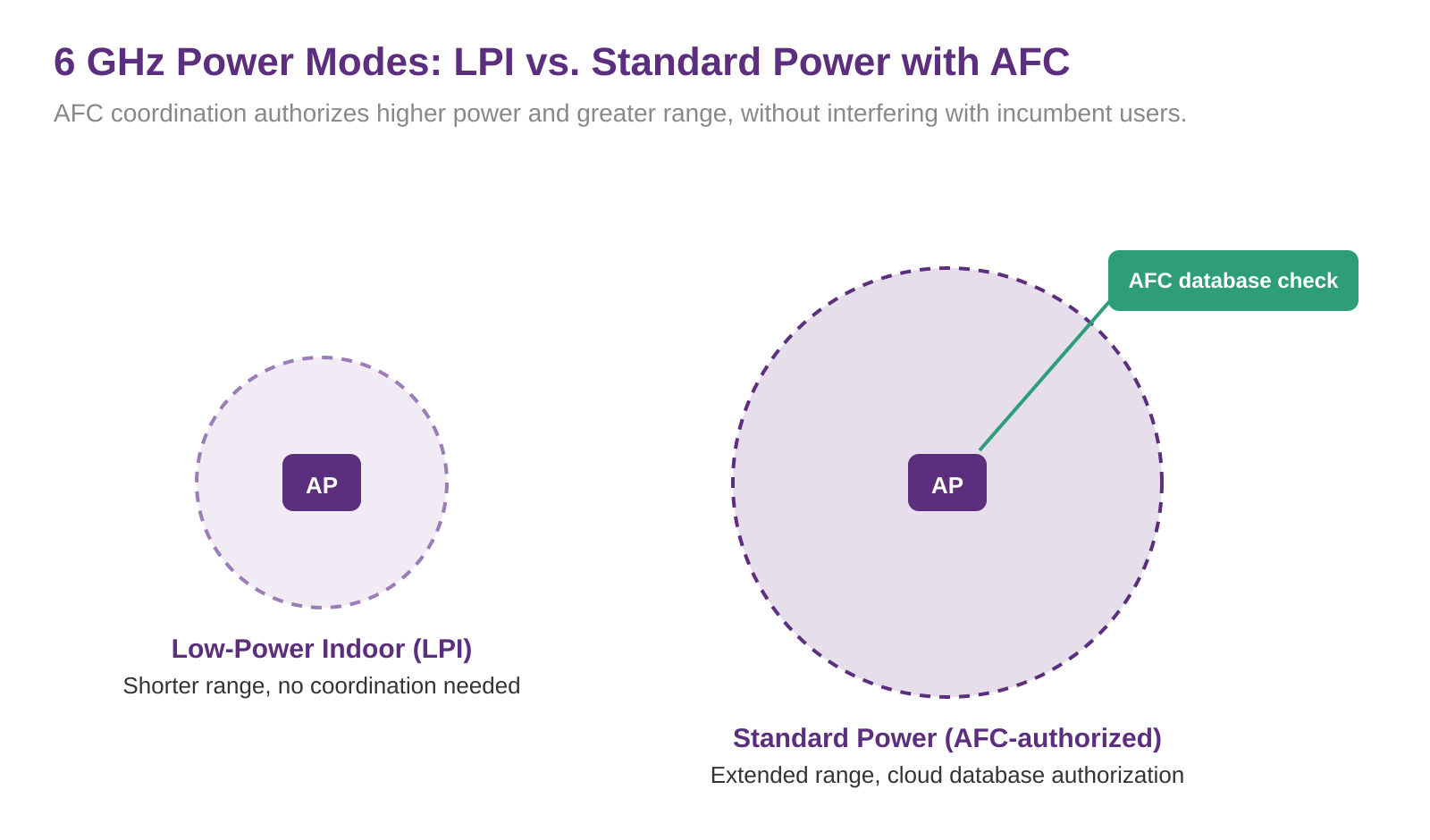
AFC (Automated Frequency Coordination) is a regulatory and technical mechanism that allows Wi-Fi access points to operate in the 6 GHz band at standard power levels — higher power and greater range than is permitted under low-power indoor (LPI) rules — by coordinating with a cloud-based database to avoid interfering with incumbent licensed users of the same spectrum, such as fixed microwave links.
The 6 GHz band is shared spectrum: alongside Wi-Fi, portions of it are also used by licensed incumbent services in some regions. To protect those incumbents from interference while still allowing Wi-Fi networks to use higher transmit power, regulators require standard-power 6 GHz access points to check their location and operating channel against an AFC database before transmitting. The AFC system determines which channels and power levels are safe to use at that location and authorizes the access point accordingly.
For a broader look at what the 6 GHz band enables for Wi-Fi 7 networks, see our 6 GHz Band glossary entry.
Key takeaway: AFC is the coordination mechanism that lets Wi-Fi networks safely use standard, higher-power 6 GHz transmission without interfering with incumbent spectrum users — extending the range and capacity benefits of the 6 GHz band beyond what low-power indoor operation alone can deliver.