



Subscribe to Our Updates
Join our community and be the first to receive exclusive insights
You are subscribed now!


.svg)

Products
Solutions
Resources
Multi-RU (Multiple Resource Unit) Allocation is a Wi-Fi 7 (IEEE 802.11be) enhancement to OFDMA that allows a single client device to be assigned more than one Resource Unit within the same transmission.
OFDMA (Orthogonal Frequency-Division Multiple Access), introduced in Wi-Fi 6, divides a wireless channel into smaller frequency segments called Resource Units (RUs). This lets an access point serve multiple client devices in parallel within a single transmission, rather than one at a time. In Wi-Fi 6, however, each client was generally limited to a single RU per transmission, regardless of how much data it needed to send or how much spare capacity was available in the channel.
Wi-Fi 7 allows a single station to be allocated multiple Resource Units at once. This means the access point can dynamically combine RUs and assign them to a client based on real-time demand, instead of being constrained to a fixed, single-RU allocation.
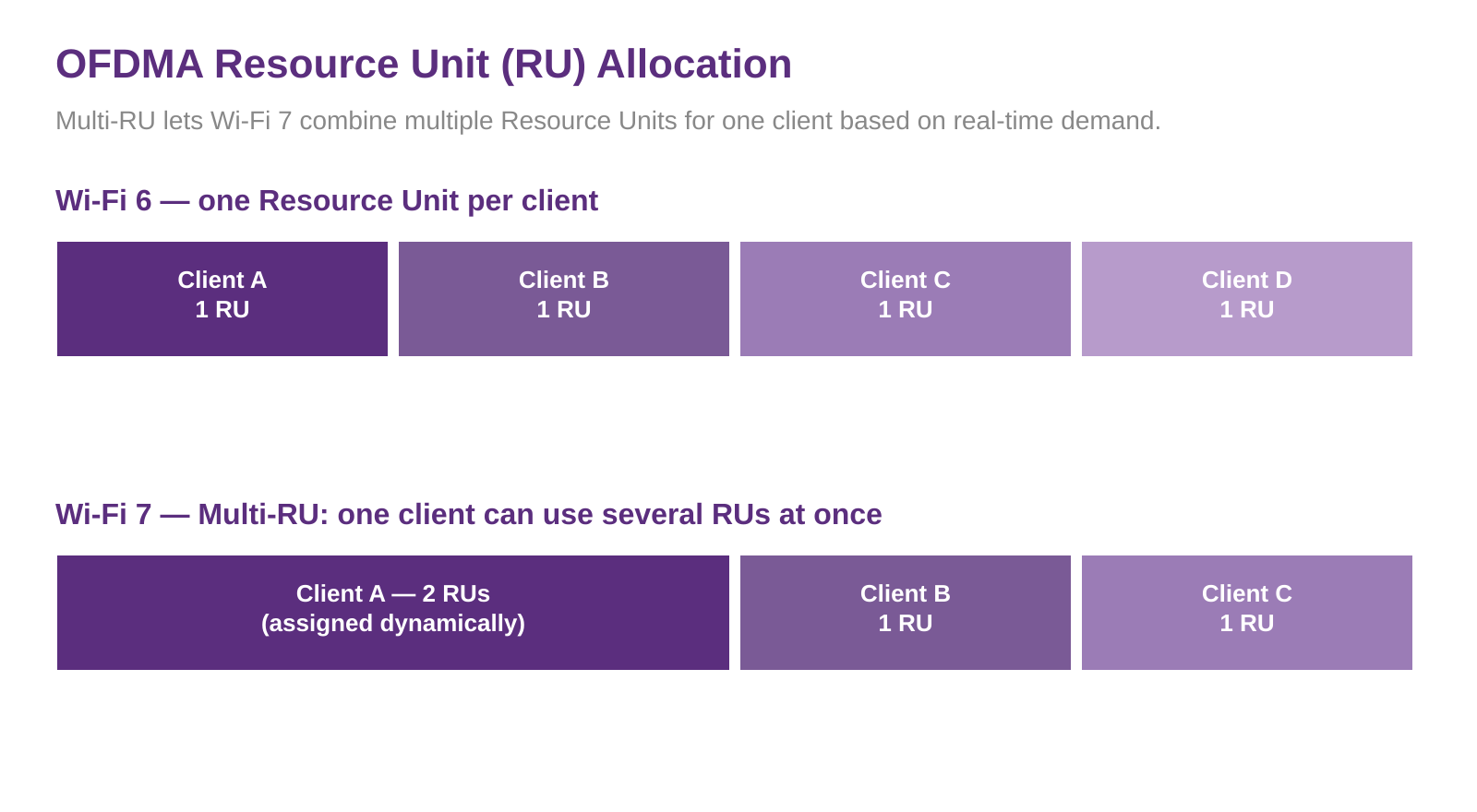
Key takeaway: Multi-RU Allocation gives Wi-Fi 7 access points finer-grained control over how channel capacity is distributed among connected clients, improving both individual client throughput and overall spectrum efficiency.
Yes. Wi-Fi 7 allows a compatible device to be assigned multiple Resource Units within the same transmission, giving the Access Point more flexibility in allocating available capacity.
Multi-RU can help use available spectrum more efficiently by allocating capacity according to the needs of different devices. This is particularly useful when a network is handling a mix of high- and low-bandwidth traffic.
In Wi-Fi 6, a client was generally assigned a single Resource Unit per transmission. Wi-Fi 7 Multi-RU allows multiple Resource Units to be assigned to the same client, making spectrum allocation more flexible.
To take advantage of Multi-RU Allocation, client devices need to support the relevant Wi-Fi 7 capabilities.