



Subscribe to Our Updates
Join our community and be the first to receive exclusive insights
You are subscribed now!


.svg)

Products
Solutions
Resources
Preamble puncturing is a Wi-Fi 7 (IEEE 802.11be) capability that lets an access point keep transmitting across a wide channel even when part of that channel is affected by interference, instead of dropping down to a narrower channel width.
In earlier Wi-Fi generations, if even a single 20 MHz sub-channel within a wide 80 MHz or 160 MHz channel was blocked by interference — from a neighboring network, radar, or another device — the access point had to abandon the entire wide channel and fall back to transmitting on a narrower one. This reduced available throughput even though most of the channel was still usable.
Preamble puncturing solves this by allowing the access point to “puncture,” or exclude, only the specific 20 MHz sub-channel that is affected, while continuing to transmit across the remaining usable portions of the wide channel.
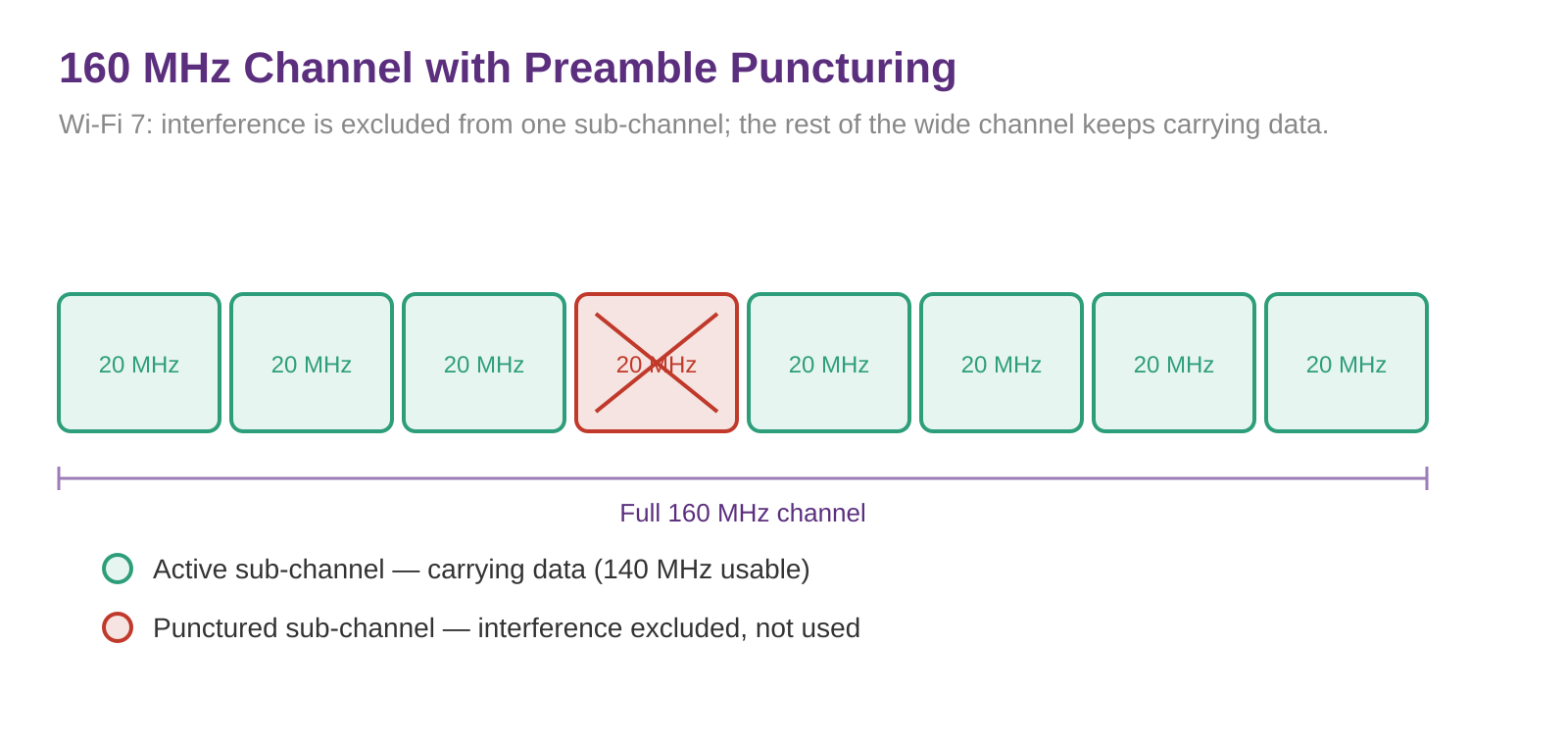
Wide Wi-Fi 7 channels are built from multiple contiguous 20 MHz sub-channels — for example, an 80 MHz channel is made up of four 20 MHz sub-channels, and a 160 MHz channel is made up of eight. With preamble puncturing, if one of those sub-channels is occupied, the access point marks it as punctured in the transmission preamble and uses the remaining sub-channels to carry data. A 160 MHz channel with a single punctured 20 MHz sub-channel can still deliver data across the remaining 140 MHz, rather than falling back to an 80 MHz or 40 MHz channel.
Key takeaway: Preamble puncturing keeps Wi-Fi 7 networks running closer to full channel capacity even when interference is present, by excluding only the affected slice of spectrum rather than abandoning the entire channel.
Reducing channel width reduces the bandwidth available to the connection. Preamble puncturing excludes only the affected portion. For example, if 20 MHz of a 160 MHz channel is punctured, the remaining 140 MHz can still be used.
Yes. Wi-Fi 7 can puncture multiple 20 MHz sub-channels within a wider channel, subject to the puncturing patterns permitted by the standard. This allows the Access Point to avoid more than one affected portion of the spectrum while continuing to use the remaining available bandwidth.
Yes. Client devices need to support the relevant Wi-Fi 7 capabilities to take advantage of preamble puncturing.
Preamble puncturing works dynamically. The Access Point identifies interference and excludes the affected part of the channel while continuing to use the remaining available bandwidth.