



Subscribe to Our Updates
Join our community and be the first to receive exclusive insights
You are subscribed now!


.svg)

Products
Solutions
Resources
4K-QAM, also written as 4096-QAM, is the highest-order modulation scheme introduced with Wi-Fi 7 (IEEE 802.11be). It increases the amount of data encoded in each transmitted symbol compared with the 1024-QAM used as the top modulation tier in Wi-Fi 6.
QAM (Quadrature Amplitude Modulation) determines how many bits of data are packed into each symbol transmitted over the air. Wi-Fi 6's 1024-QAM encodes 10 bits per symbol. Wi-Fi 7's 4096-QAM encodes 12 bits per symbol — a jump that, under sufficiently strong RF conditions, can increase peak physical-layer throughput by approximately 20% without requiring any additional spectrum.
Higher-order modulation is more sensitive to signal quality: it requires a cleaner, stronger signal-to-noise ratio to be usable, which is why 4096-QAM delivers its full benefit primarily at shorter range or in strong-signal conditions. Access points automatically step down to lower-order modulation as signal quality decreases.
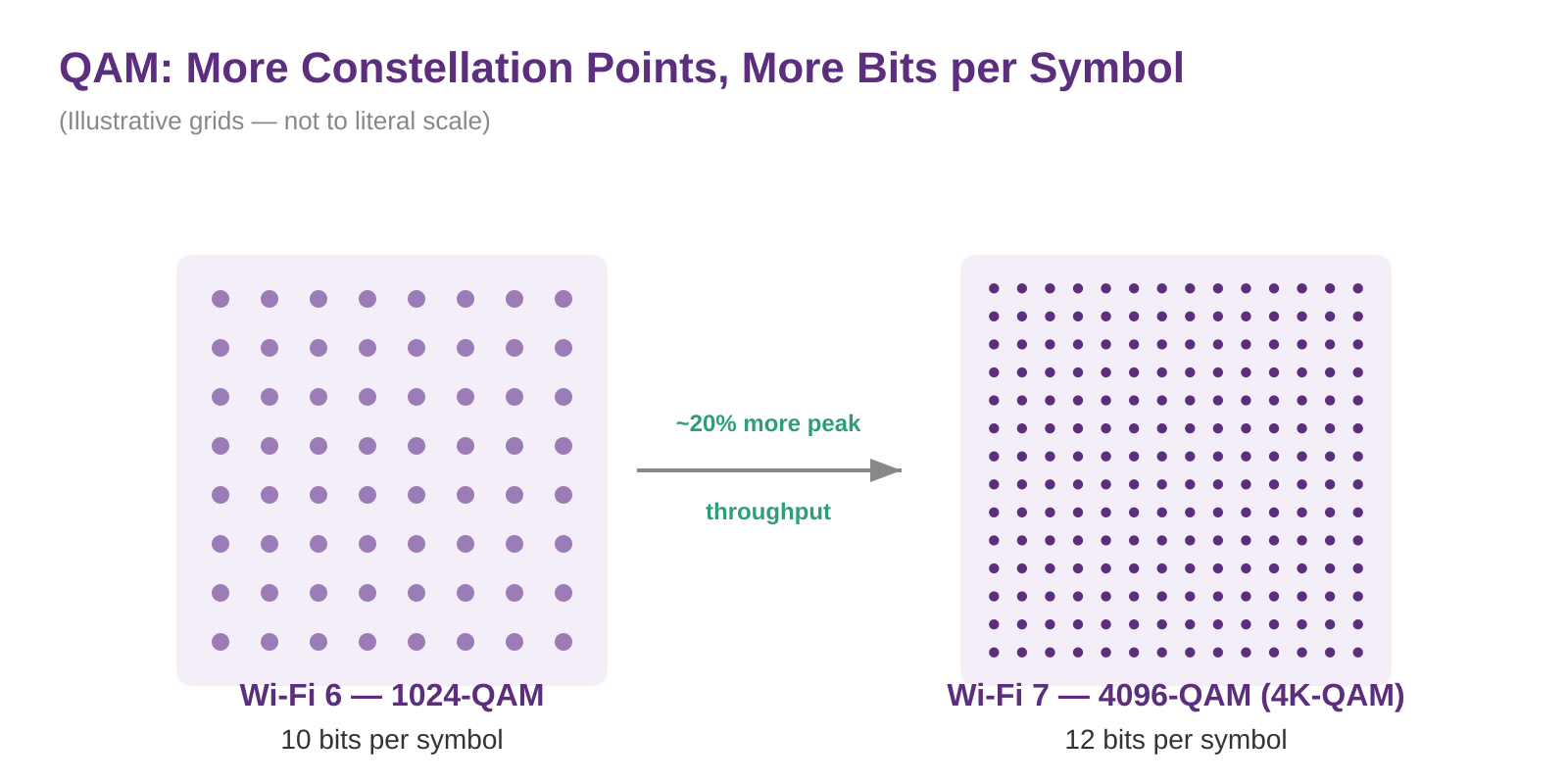
Key takeaway: 4K-QAM increases how much data each Wi-Fi 7 symbol can carry, delivering a meaningful throughput gain under good RF conditions — one of several Wi-Fi 7 technologies that combine to raise overall network capacity.