Reliable connectivity depends on more than extending a network backbone. The final stretch between an existing network and the end location can be one of the most difficult parts of a broadband deployment. Remote terrain, dispersed users, dense urban infrastructure, access permissions and the cost or time required to extend Fiber can all affect how quickly operators can connect new sites.
For telecom operators and Internet Service Providers (ISPs), the challenge is to select a last-mile approach that meets coverage, capacity, reliability and commercial requirements. Fiber remains a key foundation for high-capacity networks, but it may not be practical or economical to extend it to every location. In such situations, wireless technologies can complement Fiber and provide an alternative path to connectivity.
Unlicensed Band Radio (UBR) is one such option. By using permitted unlicensed frequency bands, UBR links can connect network sites without requiring a dedicated licensed spectrum assignment for each link, subject to applicable regulations and technical conditions. When planned and managed carefully, UBR can support broadband access, site connectivity and wireless backhaul in locations where extending physical infrastructure is challenging.
Why Does Last-Mile Connectivity Remain a Challenge?
Last-mile connectivity is the portion of a network that connects the wider communications infrastructure to a customer, business, base station or remote access point. Although it may cover a relatively short distance, this segment can involve complex deployment conditions.
Rural and remote locations
Low population density, difficult terrain and long distances between sites can make Fiber deployment expensive or slow to execute. Trenching, pole access, rights of way and ongoing maintenance may add to the total cost of connecting remote communities or isolated network locations.
Urban infrastructure constraints
In cities, operators may encounter congested ducts, limited rooftop access, complex building layouts and lengthy permissions processes. Existing infrastructure may also be shared by multiple service providers, making new physical routes difficult to secure.
Growing demand for network capacity
Broadband usage, cloud applications, video services, enterprise connectivity and mobile data traffic continue to place demands on access and backhaul networks. Operators need to expand coverage while ensuring that capacity, latency and availability remain appropriate for the services being delivered.
These conditions make a flexible network design important. In many deployments, wireless links can complement Fiber by connecting locations that are difficult to reach through a new physical route.
What Is Unlicensed Band Radio and How Does It Work?
Unlicensed Band Radio is a wireless communication system that operates in designated frequency bands where compliant devices may be used without an individual spectrum licence, provided they meet the applicable national rules. The term “unlicensed” does not mean unrestricted: permitted frequencies, transmit power, antenna characteristics, equipment standards and operating conditions vary by country and band.
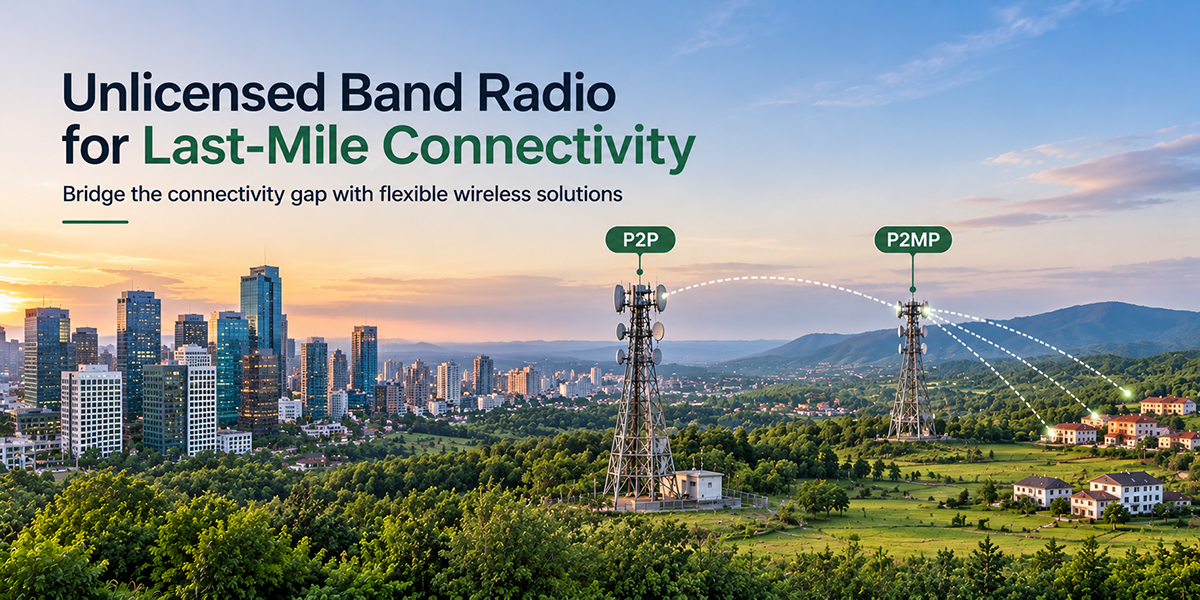
A UBR link uses radio equipment and antennas to transmit data between network locations. Depending on the network requirement, operators may deploy a dedicated Point-to-Point (P2P) connection between two sites or a Point-to-Multipoint (P2MP) arrangement in which one central site communicates with multiple remote locations.
In the 5 GHz range, wireless access and backhaul systems can offer a practical option for selected deployments. Actual performance depends on factors such as channel availability, interference, link distance, antenna alignment, line of sight, channel width, radio capability and regulatory limits.
What Are the Major Challenges of Using Unlicensed Spectrum?
Unlicensed spectrum can reduce the need for an individually assigned spectrum licence, but it is generally shared with other compliant devices and networks. Operators therefore need to account for the radio-frequency environment as part of network planning.
1. Radio-frequency interference
Nearby wireless systems may use the same or adjacent channels. Co-channel or adjacent-channel interference can reduce the signal-to-noise ratio, affect modulation, increase retransmissions and lower the usable throughput of a link. Interference conditions can also change as new networks are deployed nearby.
2. Spectrum congestion and channel availability
A channel that appears suitable during an initial survey may become busier over time. The availability of usable channels depends on local deployments, permitted frequency ranges and any applicable channel-selection or sharing requirements. Operators should avoid assuming that a particular channel will remain clear indefinitely.
3. Line-of-sight and physical obstructions
Buildings, trees, terrain and other obstructions can weaken or block a radio path. Even where visual line of sight exists, Fresnel-zone clearance and the surrounding environment can influence link performance. A site survey and link budget are important before equipment is installed.
4. Link stability and environmental conditions
Wind movement, antenna misalignment, water ingress, mounting quality and environmental exposure can affect outdoor radio links. Equipment selection, installation practices, grounding and maintenance planning should reflect the conditions at each site.
5. Capacity, throughput and latency
Theoretical radio data rates do not necessarily translate into equivalent application throughput. Shared airtime, channel width, interference, protocol overhead, traffic patterns and link quality all influence the capacity available to users. Operators should plan around expected busy-hour traffic and service-level requirements rather than headline PHY rates alone.
How Can Operators Improve the Performance of Unlicensed Wireless Networks?
Reliable UBR deployment starts with planning and continues through commissioning and ongoing monitoring. The following practices can help operators make better use of available spectrum.
Conduct a site and spectrum survey
Assess the proposed radio path, surrounding RF activity, channel availability, mounting options and expected capacity. Where possible, perform measurements at representative times because interference and utilisation may vary throughout the day.
Select channel width based on the environment
Wider channels can provide more theoretical capacity, but they also occupy more spectrum and may encounter more interference. Narrower channels can be useful in congested environments or where link margin is limited. The appropriate choice should be based on measured conditions, equipment capabilities and traffic requirements.
Optimise antenna placement and alignment
Correct antenna height, orientation, polarisation and alignment help establish a stable radio path. Link planning should account for terrain, obstructions, Fresnel clearance, cable losses and the permitted effective radiated power.
Use adaptive radio features where supported
Depending on the platform, features such as Dynamic Channel Selection (DCS) and adaptive data-rate or modulation control can help a radio respond to changing link conditions. Their behaviour and benefits should be confirmed against the product documentation and deployment design. Automated features do not remove the need for sound RF planning.
Monitor performance after deployment
Operators should track signal levels, noise, modulation, throughput, packet loss, latency, link availability and alarms. Monitoring helps identify gradual degradation, changing interference or alignment issues before they become persistent service problems.
Point-to-Point vs Point-to-Multipoint: Which Architecture Should Operators Choose?
P2P and P2MP are different network designs, and the right choice depends on the number of locations, traffic profile, geography and capacity requirements.
A P2P architecture may suit a dedicated high-capacity connection between two locations. P2MP may be appropriate when multiple endpoints can be served from a common access or distribution point. In either case, operators should assess aggregate demand, interference, line of sight, resilience and future expansion before selecting the topology.
Fiber vs Wireless Backhaul: Which Is Right for Your Network?
Fiber and wireless backhaul are not necessarily competing, mutually exclusive choices. Fiber can provide high capacity and a strong foundation for network aggregation, while wireless links can extend connectivity to locations where a new Fiber route is difficult, delayed or commercially challenging. Some network designs use both technologies to improve reach and provide alternate paths.
The decision should be based on total cost of ownership, service requirements, site conditions, route availability, capacity forecasts and resilience objectives. Wireless should not be described as a universal replacement for Fiber. It is best evaluated as part of a broader network design.
Where Does Unlicensed Band Radio Fit in 4G and 5G Network Expansion?
Mobile network expansion depends on connecting radio sites to the wider transport network. In selected scenarios, UBR can provide wireless backhaul for remote sites, connect temporary or hard-to-reach locations, extend connectivity from an existing Fiber point or serve as an alternate path in a resilient network design.
The suitability of an unlicensed-band link depends on the required capacity, distance, spectrum conditions, availability target and the operator's network architecture. It should be engineered against the traffic expected from the connected site, including future growth, rather than selected on distance or advertised data rate alone.
How IO by HFCL Supports Wireless Backhaul Deployments
IO by HFCL offers Unlicensed Band Radio solutions for wireless connectivity and backhaul applications. Its portfolio includes Point-to-Point and Point-to-Multipoint UBR options intended for different network topologies and deployment requirements.
For operators planning a wireless link, the broader deployment process matters as much as the radio itself. Link planning helps assess terrain, path conditions and capacity requirements before installation. Network management tools can support visibility and operational oversight after deployment.
IO by HFCL's existing UBR material describes capabilities including Dynamic Channel Selection (DCS), Dynamic Data Rate Selection (DDRS), interference-management algorithms, traffic aggregation and centralised management through its Element Management System. The precise feature availability and performance should be checked against the relevant product model and current technical datasheet.
By considering the radio environment, topology, capacity and management requirements together, operators can determine where UBR may complement Fiber and other backhaul technologies in their network.
Explore IO by HFCL's [Point-to-Point UBR] and [Point-to-Multipoint UBR] solutions, or connect with the team to discuss your network requirements.
Conclusion
Last-mile connectivity requires a deployment approach that reflects the geography, infrastructure, capacity and economics of each location. Unlicensed Band Radio can be a useful part of that approach, particularly where a wireless link can extend an existing network or complement Fiber infrastructure.
Its performance, however, depends on more than the frequency band alone. Spectrum assessment, link planning, antenna installation, channel selection and ongoing monitoring all contribute to a reliable deployment. For telecom operators and ISPs, evaluating these factors early can help determine where UBR is a suitable option for expanding broadband reach and supporting wireless backhaul.