


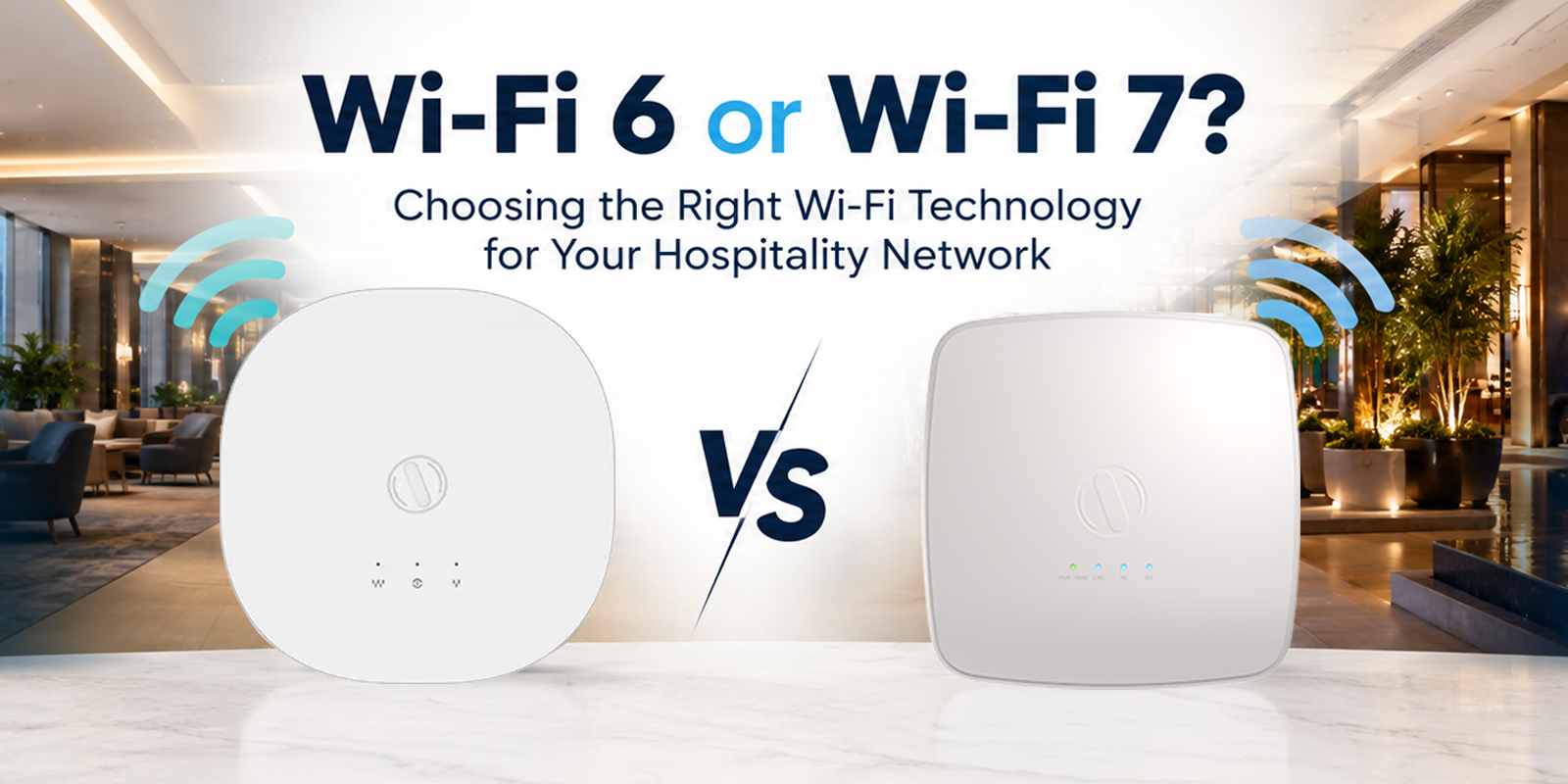
For modern hotels and resorts, Wi-Fi-based high-speed Internet access has evolved from a premium service to a basic amenity. In addition to guest access, the Wi-Fi network also supports use cases as mobile check-in, smart-room controls, surveillance, and conference/banquet Wi-Fi.
When this infrastructure falters, it disrupts operations, frustrates guests, and affects brand trust. This makes the choice of wireless technology an important part of hospitality infrastructure planning. Wi-Fi 6 remains a strong, cost-effective choice for many existing properties, while Wi-Fi 7 offers improved performance in terms of latency and throughput.
So, should your network choose Wi-Fi 6 or move to Wi-Fi 7? The answer depends on the property size and layout, Wi-Fi enabled services, network architecture, and whether the existing wired and wireless infrastructure can support the capabilities being introduced. Here is what has changed with Wi-Fi 7, where it justifies the investment, and where a well-designed Wi-Fi 6 network still delivers a strong guest experience.
Key Wi-Fi 7 Capabilities for Hotel Networks
Wi-Fi 7 goes beyond higher speeds. Its value for hospitality lies in how it improves capacity, connectivity and performance in increasingly connected guest environments. For hotels and resorts evaluating Wi-Fi 7, four capabilities are particularly relevant.
Multi-Link Operation (MLO): Keeping Guest Connections Stable
Wi-Fi 7's Multi-Link Operation (MLO) allows compatible devices to establish a multi-link connection across available bands or channels. Depending on the device and MLO mode, traffic can be transmitted over multiple links or dynamically shifted between links to improve throughput, latency and connection reliability. This can improve throughput, reduce latency and provide more consistent connectivity, particularly when one link experiences congestion or interference.
For hotels/resorts, this can help keep guest video calls, streaming sessions and smart-room applications more consistent, particularly in busy areas where guests or IoT devices compete for wireless resources such as lobbies, conference halls and restaurants.
320 MHz Channel Width and 4096-QAM: Higher Wireless Capacity for Bandwidth-Intensive Areas
Wi‑Fi 7 supports 320 MHz channels in the 6 GHz band and uses a more efficient signal method (4096‑QAM modulation), enabling higher throughput and greater wireless capacity. Given the relatively proximity of in-room Wi-Fi access points to the end user, benefits of 4096-QAM will be easier to achieve. 320MHz benefits depend heavily on client capability though.
For hotels, capacity is critical in high‑density areas like ballrooms and conference halls, where applications such as live streaming, photo/video uploads, live demos etc require robust, high-speed Wi-Fi connectivity with high concurrency.
Preamble Puncturing: Better Performance Amid Interference
Hospitality environments can be challenging from an RF perspective. A hotel has guest rooms, meeting rooms, and dining spaces where Wi-Fi access is required with many connected devices operating within the same building in proximity. This can result in high channel reuse, especially when wider channels are in use. Wi-Fi 7's preamble puncturing feature allows an access point to handle interference more gracefully. The AP can puncture an interference-affected portion of a wider channel while continuing to use the remaining usable spectrum for transmission.
The practical advantage is greater spectrum efficiency in dense hotel environments like convention centres, large resorts and properties with closely spaced access points, where interference can otherwise reduce usable capacity.
6 GHz: More Room for High-Density Hospitality
Wi-Fi 7 supports operation in the 6 GHz band, building an additional, relatively cleaner spectrum alongside the existing 2.4 GHz and 5 GHz bands, subject to local regulations. For hotels, this additional spectrum accommodates growing device density, relieving pressure on the already busy 2.4 GHz and 5 GHz bands.
Where Wi-Fi 7 Changes the Game in Hotel Networks
Wi-Fi 7 is particularly well suited to properties preparing for dense deployments, bandwidth-intensive applications, and a longer technology lifecycle.
High-Density spaces: Ballrooms, Convention Floors and Event Lobbies
Large events can bring hundreds of users and devices into one space very quickly, putting dozens or hundreds of devices on the same access points. Wi-Fi 7’s higher peak rates, Multi-Link Operation (MLO), wider channels, and the resulting better spectrum efficiency help spread that load across bands, reducing congestion and buffering and dropped calls under demanding conditions.
Smart hotel rooms and IoT
Smart rooms can include connected lighting, HVAC controls, smart TVs, room tablets, sensors, and other devices. Wi-Fi 6 remains a strong fit for many IoT deployments. Wi-Fi 7 becomes relevant as hotels add more connected devices and introduce applications that require higher bandwidth or lower latency, e.g., gaming consoles, ultra-HD streaming devices.
Guest rooms with multiple devices
Guests increasingly connect several personal devices at once, from smartphones and laptops to tablets and smart TVs. In premium properties, this demand is further amplified by high-bandwidth entertainment and connected in-room services. Wi-Fi 7 can provide additional capacity for these multi-device environments, particularly in properties with a strong focus on premium digital experience
The Infrastructure Behind Wi-Fi 7
Wi-Fi 7 delivers its full value only when the hotel’s wired network can keep pace.
Multi-gigabit uplinks
Wi-Fi 7 APs can deliver more than 1 Gbps of wireless throughput, making legacy 1G switch ports a potential bottleneck. 2.5G and higher speed uplinks help get the full benefits of Wi-Fi 7.
PoE capacity
Wi-Fi 7 APs can have higher power requirements than typical Wi-Fi 6 APs. The PoE infrastructure must be capable of supporting the required power.
When Wi-Fi 6 is the right choice for a Hotel
Wi-Fi 6 remains a strong choice for hotels that need reliable connectivity across guest rooms, public areas and back-of-house operations, particularly when:
- The majority of guest devices support Wi-Fi 5 or Wi-Fi 6.
- The property has moderate throughput capacity requirements.
- The hotel wants a mature technology with a strong balance between performance and deployment cost.
The quality of the network design matters just as much as the Wi-Fi technology features. AP placement, channel planning, interference management, wired connectivity, PoE capacity and network monitoring all influence the guest experience.
Wi-Fi 6 vs Wi-Fi 7: A quick Comparison
How to Choose Between Wi-Fi 6 and Wi-Fi 7?
There is no universal answer to Wi-Fi 6 vs Wi-Fi 7 for hospitality. Both Wi-Fi 6 and Wi-Fi 7 are designed to improve wireless performance in environments where multiple devices compete for network capacity. Choosing between these network solutions for hotels depends on the requirements of each deployment zone, including client density, application traffic, client capabilities, 6 GHz availability, RF conditions, and wired-network readiness. Hotel IT solutions do not require a uniform hardware approach across every square foot of the property. A mixed deployment often makes the best financial and technical sense for a hospitality business.
IT teams can install Wi-Fi 6 access points in guest rooms to maintain reliable, high-speed connectivity. Meanwhile, high-density zones like convention halls or areas with particularly high client density or bandwidth demand might benefit from targeted Wi-Fi 7 installations. Evaluating your current LAN cabling and switch capacity is the very first step before committing to either standard. A powerful hospitality network management system will allow administrators to monitor and manage both standards effectively under a single dashboard.
Build the Right Hospitality Network with HFCL
IO by HFCL brings together high-performance Wi-Fi access points, managed PoE switches, and IO Canvas, its AI-powered centralized network management platform, to deliver reliable, scalable connectivity across guest rooms, public areas, high-density spaces, and back-of-house operations. The portfolio supports flexible Wi-Fi 6 and Wi-Fi 7 deployments, helping hotels match network technology to their specific density, application, and infrastructure requirements.






.svg)