



With USD 14.3 billion in projected growth by 2030, the Emirates' warehousing and fulfilment sector is scaling fast. The question is whether the network underneath can keep up.
It's 11:47 PM at a fulfilment centre in Jebel Ali. Thousands of orders are queued for next-morning delivery. Pickers are moving. Conveyors are running. And then, a barcode scanner drops off the network. Then another. Within minutes, the warehouse management system loses visibility across an entire zone.
For 52 minutes, nothing ships.
The cost isn't just the delayed orders. It's the Service Level Agreement (SLA) breach. The client calls at 7 AM. The penalty clause. The competitor who now looks more reliable.
This isn't a cautionary tale. It's a Tuesday.
Across the UAE's fastest-growing logistics corridors - Dubai Industrial City, Jebel Ali Free Zone, Abu Dhabi Logistics City, warehouses and fulfilment centres are scaling up at a pace the country hasn't seen before. But many are doing it on networks that were never built for what modern logistics actually demands.
A Market Growing Faster Than Its Infrastructure
The numbers tell the story clearly. The UAE logistics market is expected to grow by USD 14.3 billion between 2026 and 2030, driven by a CAGR of 8.2%. Digital transformation, through blockchain, telematics, and IoT is reshaping the sector from the ground up.
The strongest demand is coming from three areas:
• Integrated logistics providers scaling multi-site operations across emirates
• E-commerce operators building omnichannel fulfilment to meet next-day and same-day delivery expectations
• Food, FMCG, and pharma companies expanding temperature-controlled capacity as cold chain compliance tightens
Each of these sub-sectors shares one critical dependency: they run on data. And data runs on the network.
The Network Problem Nobody Talks About

Walk into most warehouses and you will find the same scene: a mix of consumer-grade routers bolted to walls, patchy WiFi that fades in the corners of the floor, switches that weren't designed for industrial environments, and no real visibility into what's connected or what's failing.
This works - until it doesn't.
High-ceiling environments scatter WiFi signals in ways that office-grade access points simply cannot compensate for. Metal shelving creates interference and dead zones. The density of simultaneously connected devices such as scanners, terminals, cameras, IoT sensors, mobile devices overwhelm networks not designed for industrial load.
"Consumer-grade routers weren't built for warehouses. Industrial operations need industrial networks."
And as operations become more automated with conveyor systems, RFID readers, automated picking arms, and real-time WMS integrations, the tolerance for network failure approaches zero. A 50-minute outage used to mean a delayed shipment. Today, it means a halted automated line, a missed SLA, and a damaged client relationship.
What Industrial-Grade Network Infrastructure Actually Looks Like
The UAE's leading logistics operators are moving toward a full-stack approach to network infrastructure - one that treats connectivity as mission-critical, not an afterthought. Here's what that looks like in practice:

Industrial WiFi Across the Entire Warehouse Floor
Enterprise-grade access points purpose-built for high-ceiling, high-interference environments. Strategic placement that eliminates dead zones, not just in the office area, but across every aisle, every loading bay, and every corner of the operation. A picker who loses signal halfway down an aisle isn't just inconvenienced, they are offline.
Ruggedized Switches for a Unified Device Backbone
Every device in a modern fulfilment centre i.e. barcode scanners, conveyor systems, RFID readers, security cameras, WMS terminals, IoT sensors needs to communicate on one stable, unified network. Ruggedized switches built for industrial environments handle the device density, the vibration, the temperature variance, and the 24/7 uptime demands that office-grade hardware simply cannot.
Network Management: Visibility Across Every Site
For multi-site 3PL operators and logistics providers managing warehouses across Dubai, Abu Dhabi, and Sharjah, the real game-changer is centralized network management. A single portal that provides real-time visibility across all access points, connected devices, and locations - so faults are flagged and resolved before they cascade into an operational stoppage.
No on-site IT team required. No flying blind across locations. Just full control, from one screen.
A Special Note for FMCG and Pharma Operators
Temperature-controlled logistics carries a compliance burden that other sectors don't. Whether it's food safety standards, pharmaceutical cold chain regulations, or export documentation requirements, the data flowing through your network isn't just operational, it's regulatory.
"Your temperature-controlled cargo is too valuable to run on an unmanaged network."
An unmanaged network in a cold chain facility isn't just a risk to SLAs. It's a risk to product integrity, regulatory compliance, and ultimately, patient or consumer safety. HFCL’s managed network infrastructure gives FMCG and pharma operators the visibility, redundancy, and control that their operations and their regulators demand.
The Network Is No Longer a Back-Office Problem
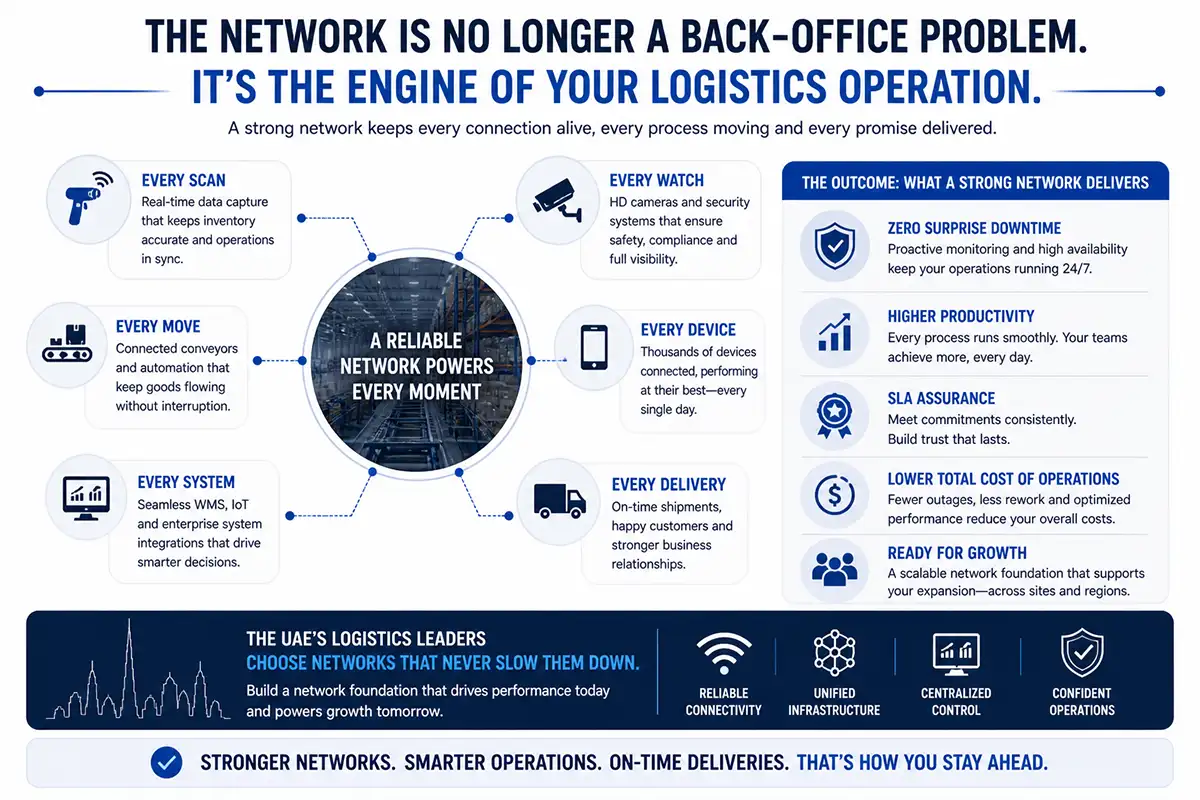
The UAE's logistics sector is growing at a pace that demands a fundamental rethink of what network infrastructure means. It's not a cable in a server room. It's the connective tissue of your entire operation, the thing that keeps every scanner scanning, every conveyor moving, every shipment on time.
As the sector scales toward its 2030 growth targets, the operators who invest in enterprise-grade, full-stack network infrastructure today will be the ones running efficient, resilient, multi-site operations tomorrow.
The ones who don't will still be explaining why nothing shipped for 52 minutes.
HFCL provides industrial WiFi, ruggedized switches, and centralized network management solutions purpose-built for the UAE's logistics and warehousing sector. One network. Full visibility. Zero tolerance for downtime.
Is your warehouse network built for what's coming?
Talk to us about full-stack network solutions for logistics and industrial operations across the UAE.






.svg)