


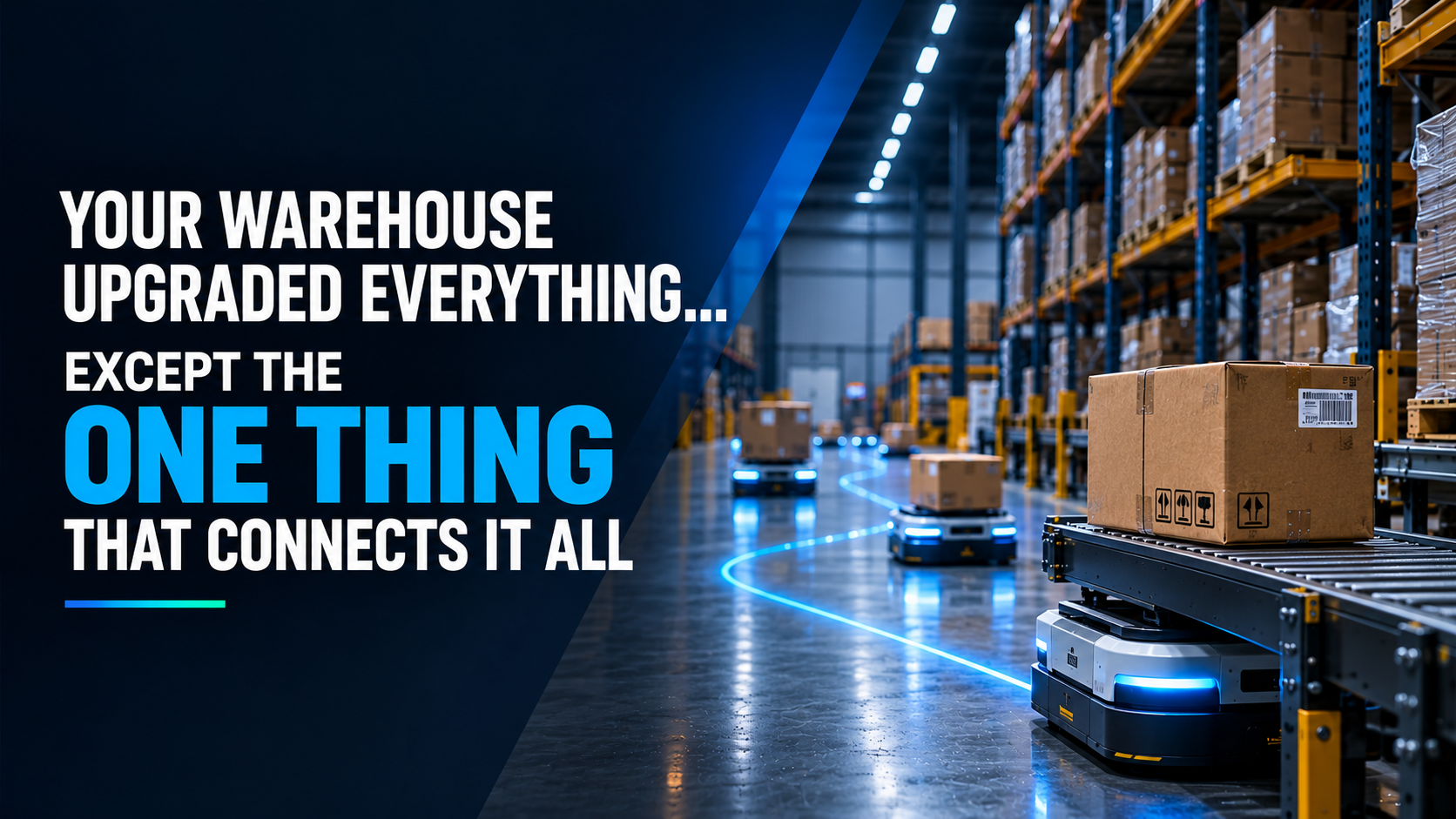
The UAE logistics sector is investing billions in automation, AI, and cold chain technology. Yet the network sitting underneath it all is still running on yesterday's infrastructure. Here's why that gap is becoming the industry's most expensive blind spot.
Ask any operations director at a UAE logistics company what keeps them up at night and you will hear the same answers: SLA breaches, rising fuel costs, driver shortages, last-mile complexity.
You will almost never hear: the network. And that's exactly the problem.
The UAE's warehousing and fulfilment sector has undergone a remarkable transformation over the past five years. Warehouse management systems have become sophisticated platforms. Barcode scanning has given way to RFID. Cold chain facilities now carry IoT sensors that log temperature data every 30 seconds. E-commerce operators are building omnichannel fulfilment centres that rival the complexity of small airports.
But walk into most of these facilities and look at the network infrastructure, the access points, the switches, the cabling and you will often find something that hasn't kept pace. A patchwork of consumer-grade routers. Switches that weren't designed for industrial load. WiFi coverage that works in the office but drops out in the far corners of a 50,000 sq ft warehouse floor.
The investment in technology has been real. The investment in the infrastructure that connects that technology has lagged far behind.
Most logistics operators are running 2015 networks underneath 2026 operations, and they won't know it until something breaks badly.
A Sector Scaling at a Pace That Demands More
The numbers put the challenge in perspective. The UAE logistics market is projected to grow by USD 14.3 billion between 2026 and 2030 at a CAGR of 8.2%. This growth is already visible in new warehouse developments across Dubai Industrial City and Jebel Ali Free Zone, along with expanding cold storage facilities in Abu Dhabi. Its e-commerce fulfilment hubs being built to serve a consumer base that now expects next-day delivery as standard.
The demand is coming from three directions simultaneously:
• Integrated logistics providers scaling multi-site operations and needing consistent, centrally managed connectivity across every facility
• E-commerce operators building omnichannel fulfilment that requires real-time inventory visibility, automated picking systems, and zero tolerance for connectivity gaps
• Food, FMCG, and pharma companies expanding temperature-controlled capacity where network reliability isn't just operational - it's a compliance requirement
Each of these growth vectors places a heavier load on network infrastructure than the one before it. And yet the conversation in boardrooms and operations meetings is almost always about the technology at the top of the stack, the WMS, the automation, the sensors, rather than the network at the bottom that makes all of it work.
The Hidden Cost That Doesn't Show Up on the P&L
Here is what a network failure costs a UAE fulfilment operation and why it rarely gets attributed to the network itself.
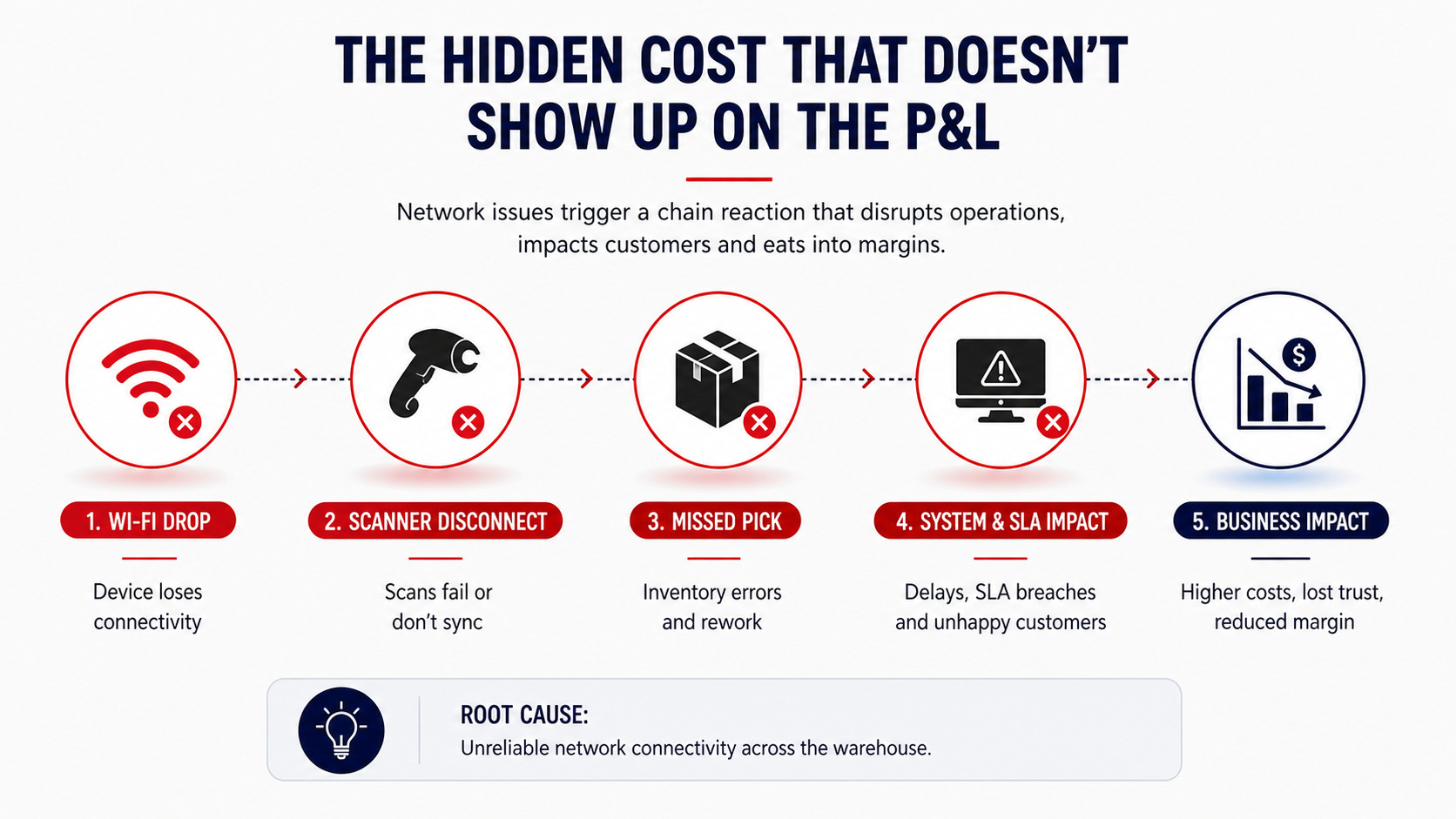
A barcode scanner drops off the WiFi. The picker moves on, assuming it will reconnect. It doesn't. Three picks are missed. The WMS flags an inventory discrepancy. A supervisor spends 20 minutes investigating a system error that isn't a system error, it's a dead zone on the warehouse floor.
An RFID reader on a loading dock loses connectivity. A shipment goes out unlogged. It shows up as a missing item in the client's system. The client raises a dispute. Your team spends two days tracing it. The root cause - a switch that wasn't built for the temperature variance of a loading dock environment, never gets identified.
A cold chain facility's monitoring sensors lose network connectivity for 40 minutes during a peak shift. The temperature log has a gap. The batch fails compliance review. The product is quarantined. The cost runs to six figures.
In each of these scenarios, the incident gets logged as a WMS issue, a hardware failure, a staff error, or just bad luck. Meanwhile, the network often goes unexamined as the root cause because there is no visibility.
The most expensive network problems aren't the ones that take everything down. They are the ones that quietly degrade performance and get blamed on everything else.
What Industrial-Grade Network Infrastructure Actually Means
The phrase 'enterprise networking' gets used loosely. In a logistics context, it means something specific - infrastructure that is purpose-built for the physical environment, the device density, and the operational demands of a modern warehouse or fulfilment centre. That means three things working together:
1. Industrial WiFi That Covers the Whole Floor - Not Just the Office
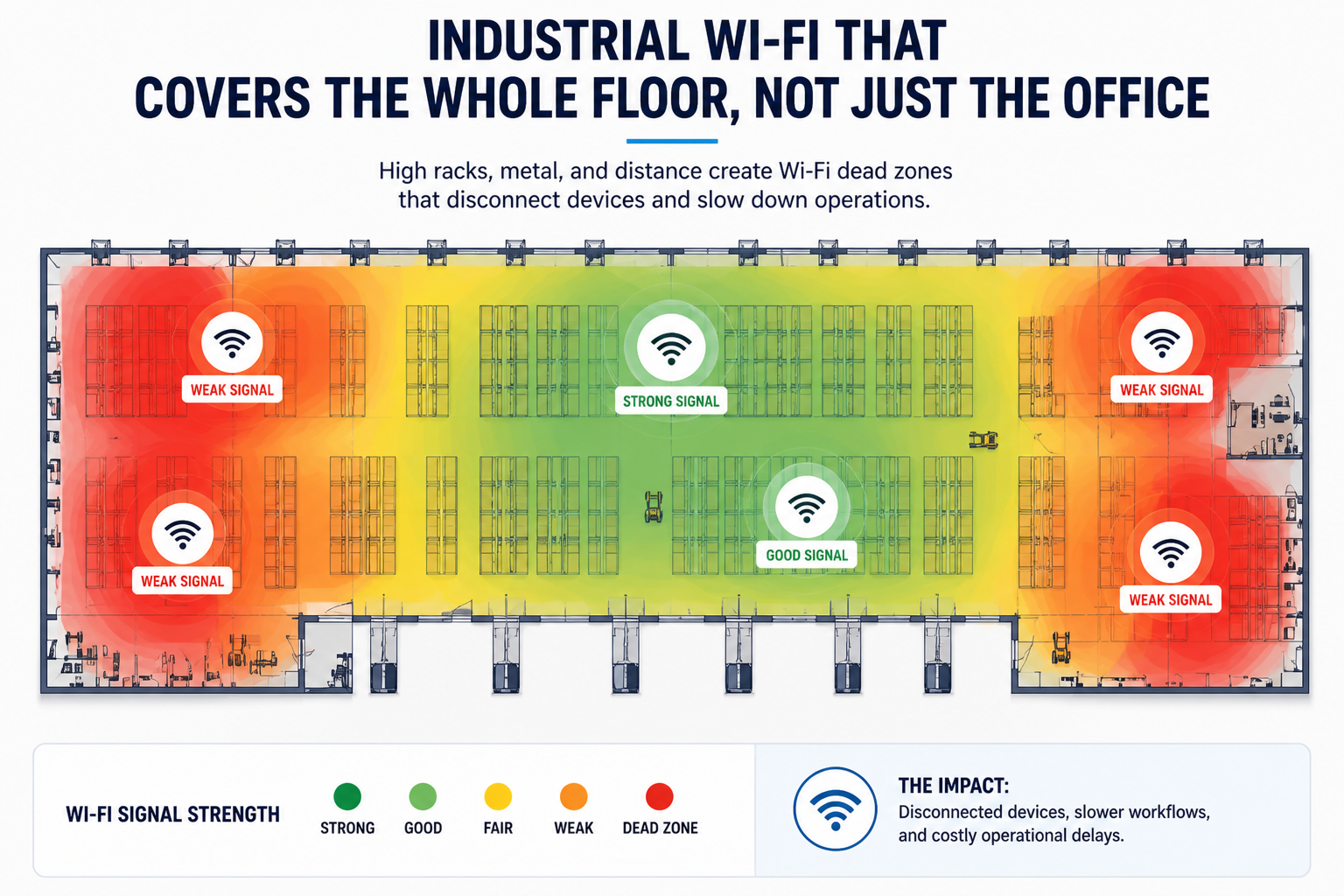
High-ceiling warehouses with metal racking are some of the most challenging environments for WiFi. Signals scatter, and dead zones form in predictable patterns that office-grade access points cannot effectively handle. The result is not just slow connectivity, but disconnected scanners, dropped mobile terminals, and pickers unknowingly going offline for minutes at a time.
Industrial WiFi access points, strategically placed and properly configured for the physical environment, eliminate these dead zones across every aisle, every loading bay, and every corner of the operation. Not just where the WiFi feels strong, everywhere a device needs to connect.
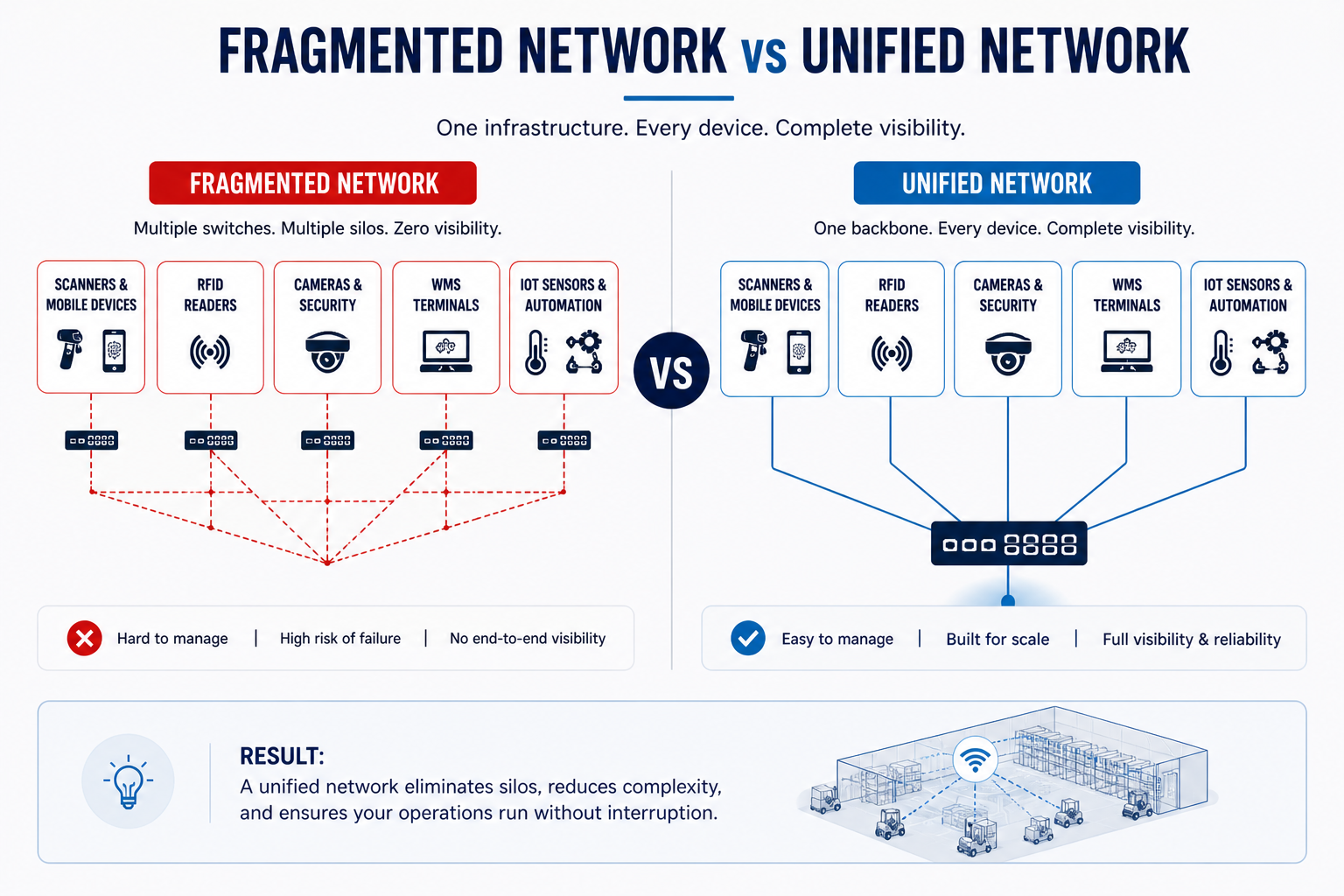
2. Ruggedized Switching That Unifies Every Device on One Backbone
A modern fulfilment centre runs on dozens of different connected systems: barcode scanners, RFID readers, conveyor controllers, security cameras, WMS terminals, IoT temperature sensors, automated picking systems. In most facilities, these devices connect to different switches, on different network segments, with no unified view of what is connected and what is not.
Ruggedized industrial switching brings every device onto a single, managed backbone, one that handles the device density, the temperature variance, the vibration, and the 24/7 uptime demands that office-grade hardware was never designed for. When everything is on one network, visibility becomes possible. When visibility is possible, problems get found before they become outages.
3. Network Management That Gives You Control Across Every Site
For logistics operators managing warehouses across Dubai, Abu Dhabi, and Sharjah or scaling toward that model, the most valuable capability is centralised network management. A single portal that provides real-time visibility across every access point, every connected device, and every facility.
This is the difference between finding out about a network problem when an operations manager calls at 2 AM, and finding out about it before it affects a single shipment. Proactive monitoring. Fault detection. Remote resolution. All without an on-site IT team at every location.
The Operators Who Will Win the 2030 Race Are Making This Decision Now
The UAE logistics sector's growth trajectory is not in question. The USD 14.3 billion expansion happening between now and 2030 will create the most sophisticated warehousing and fulfilment infrastructure the region has ever seen.
The question is which operators will scale cleanly and which will scale into compounding infrastructure problems.
The ones who will win are already rethinking the network - not as a cost line on a facilities budget, but as a strategic foundation. They understand that every dirham invested in WMS platforms, automation, and IoT technology delivers its full return only when the network underneath it is reliable, visible, and built for the environment it operates in.
The ones who won't are the ones who will keep investigating WMS errors, staff incidents, and hardware failures, never quite realising that the root cause was always the network they never looked at.
The best logistics technology in the world underperforms on a network that wasn't built to carry it.
HFCL provides full-stack network infrastructure - industrial WiFi, ruggedized switching, and centralised network management, purpose-built for the UAE's warehousing, fulfilment, and cold chain sector. One network. Complete visibility. Built to scale.
Has your operation outgrown its network?
Talk to us about industrial WiFi, switching, and network management solutions built for UAE logistics and warehousing operations.






.svg)