.svg)



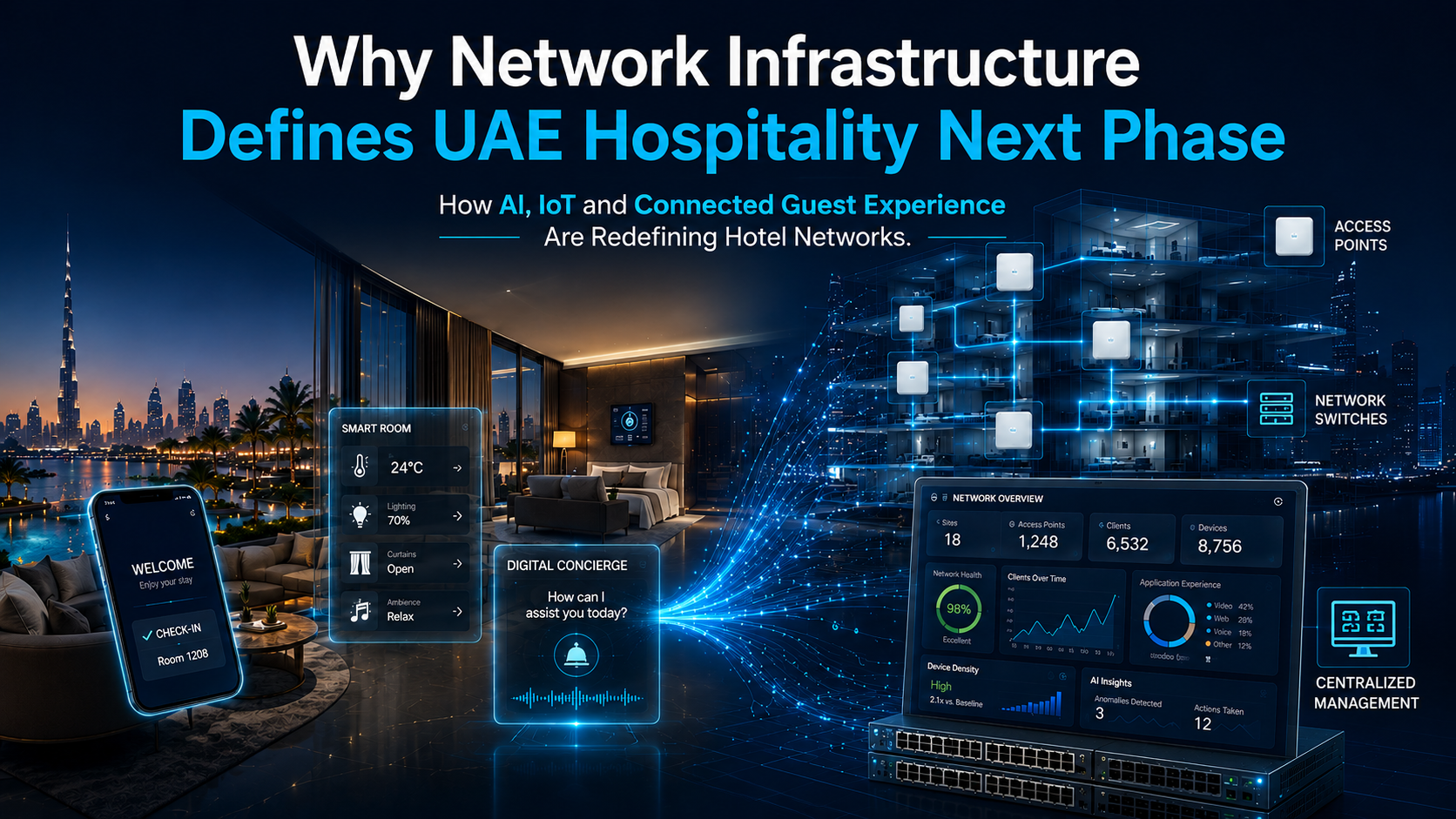
The UAE has never competed on price. From the early days of iconic properties like Burj Al Arab, the country has set global benchmarks in hospitality defined by exceptional guest service, operational precision, and the ability to deliver luxury at scale.
That standard is now being rewritten again. And this time, the shift is happening behind the scenes. The competitive edge lies in the network infrastructure powering every digital interaction across the guest journey.
AI Moves from Experimentation to Execution in UAE Hospitality
Across UAE hospitality boardrooms, AI has rapidly moved from experimentation to execution. Leading hotel groups in the UAE are no longer exploring its potential; they are actively integrating AI-driven intelligence across the guest journey.
What AI Deployment Looks Like in Hotels Today
From operations to personalized guest experiences, AI is already reshaping how hotels operate and how guests experience their stay. AI-powered concierge systems are responding to guests' needs faster before they are voiced. Predictive maintenance frameworks identify and resolve issues before guests notice them. Personalised in-room environments adjust lighting, temperature, and entertainment to individual profiles. Pricing engines are responding to demand signals in real time
This shift is not accidental. It is driven by a strong national push toward digital leadership, supported by national initiatives such as UAE Vision 2031 and the Dubai Economic Agenda (D33), which targets doubling Dubai's GDP and attracting 40 million visitors annually by 2033. These initiatives are accelerating AI adoption across industries, including hospitality.
The scale of that movement is significant. The UAE’s hospitality pipeline remains one of the most active in the world with nearly 27,000 new hotel rooms expected to come online across the UAE by 2030, driven by sustained growth in tourism and MICE activity. Importantly, many of these are not legacy properties retrofitting digital capabilities. New-age hospitality developments are being designed with AI-enabled services, intelligent building systems, and the network infrastructure to support them from the ground up, treating it as a core pillar of the brand proposition rather than an add-on.
Yet, amid this rapid adoption, one critical question remains underexamined. What happens when the network cannot keep up?
Every AI-Driven Hotel Experience Runs on One Thing - Your Network
Every AI-led experience in a modern hotel, every IoT sensor, every guest-facing interface, every real-time data pipeline runs on network infrastructure. The responsiveness of an AI concierge is governed by latency. The predictive maintenance system is only as accurate as the uninterrupted data stream feeding it. And personalised guest experiences rely on stable high-density connectivity across hundreds of devices at the same time.
Consider the operational reality of a large hotel in UAE during peak occupancy. At any given time, it may be handling 5,000 or more simultaneously connected devices from guest phones and laptops drawing on hotel WiFi to in-room smart systems, kitchen operations platforms, security infrastructure, staff tools, and AI applications, all running on the same hospitality network and competing for bandwidth. This level of device density is not a future scenario. It is already the current operational baseline, and it is rising.
Research cited by Gulf News, based on TNS Connected Life, found that the average UAE adult owns at least four connected devices, including smartphones, laptops, tablets, and wearables, and expects technology-driven, always-connected stay experiences. A figure that has more than doubled in five years.
What makes this challenge particularly difficult to manage is that network failure in this context is rarely dramatic. Enterprise AI does not collapse under pressure. It degrades quietly. A slightly overloaded network doesn't crash the system. It slows response times, drops IoT data points, and disrupts the personalisation loop. Guests don’t see an error message. They simply experience that things aren’t working as expected. A slower response from the AI concierge, smart room settings that don’t match their preferences, or recommendations that feel off.
In a hospitality market where the margin between a five-star and a seven-star experience is measured in fractions, even small degradations in the guest experience have a measurable business impact. It impacts guest perception, loyalty scores, and ultimately, revenue per available room. (RevPAR)
What Hospitality Network Infrastructure Looks Like in 2026?
Enterprise-grade hospitality network solutions in a modern hospitality context are no longer simply about bandwidth. They encompass three critical dimensions that UAE operators need to evaluate now.
Capacity Architecture: Built for Tomorrow's IoT and AI Device Density
It represents the first pillar of modern hospitality infrastructure. Hotel networks must be designed not for current demand, but for exponential growth where AI and IoT ecosystems could drive device volumes to multiples of today’s baseline over the next few years.
With International Data Corporation (IDC) forecasting global IoT investments to grow at roughly 10–11% CAGR through 2027, hospitality environments are expected to see a continued rise in connected endpoints, smart systems, and bandwidth-intensive digital services. Yet many hotel networks operating today were never designed for this scale, level of concurrency, or operational intelligence.
Network Segmentation and Security for Hotel Environments
Segmentation and security form the second pillar. As hotels become more connected, operational risks also increase in proportion. Guest WiFi networks, Property management systems, smart room controllers, and AI application layers need to be intelligently segmented, robust enough to protect sensitive operational data, yet fluid enough to avoid the internal friction that slows staff response and degrades the guest experience. The UAE properties that serve high-profile international guests, this balance carries reputational weight that extends beyond operational risk.
Real-Time Network Visibility - The Competitive Advantage Most Hotels Overlook
The third, and often overlooked, dimension is real-time visibility. The ability to continuously monitor network behaviour, detect anomalies before they escalate, and generate actionable intelligence is no longer the exclusive domain of large enterprise IT teams. In an AI-driven hospitality environment, a network management system providing real-time visibility across every access point, every connected device, and every property is foundational.
For hotel groups managing multiple hospitality properties across Dubai, Abu Dhabi, and Sharjah, centralised network management transforms the operational model entirely from reactive fault response to proactive resolution, often before a single hotel guest is affected.
As the hotel network that cannot observe itself cannot evolve. And in an AI-driven ecosystem, that limitation compounds rapidly.
Why Your Hotel Network Is Now a Strategic Business Asset, Not Just IT
UAE hospitality is entering a new phase. Brand differentiation will increasingly depend on how well hotels use data. How deeply they understand their guests, how accurately they anticipate guest expectations, and how consistently they deliver across every touchpoint of the guest stay.
This, in turn, puts the hotel network at the centre of value creation. Hotels that see their network infrastructure as a strategic enabler, not just an operational layer, will extract the full return from their AI and hospitality technology investments. They will be able to deliver consistent, high-quality guest experiences that strengthen their brand equity over time.
Those who don’t may face a growing, compounding gap. They will invest in advanced hospitality technology solutions, but struggle to deliver the guest experiences those technologies promise because the hospitality network sitting underneath them was never built to carry them.
In a market as competitive as the UAE, these gaps don’t stay hidden for long.
Because in the next phase, it will not be the most visible innovations that define success, but the strength of the invisible systems that sustain them.
Evaluate Your Hotel Network for the UAE's Next Phase of Hospitality Growth
Ready to evaluate your hotel network for what's coming? Talk to us about hospitality network solutions purpose-built for the UAE - from Wi-Fi 6 access points and managed network switches for hospitality to a centralized network management system that gives you real-time control across every property.
One network. Complete visibility. Built to scale.






.svg)